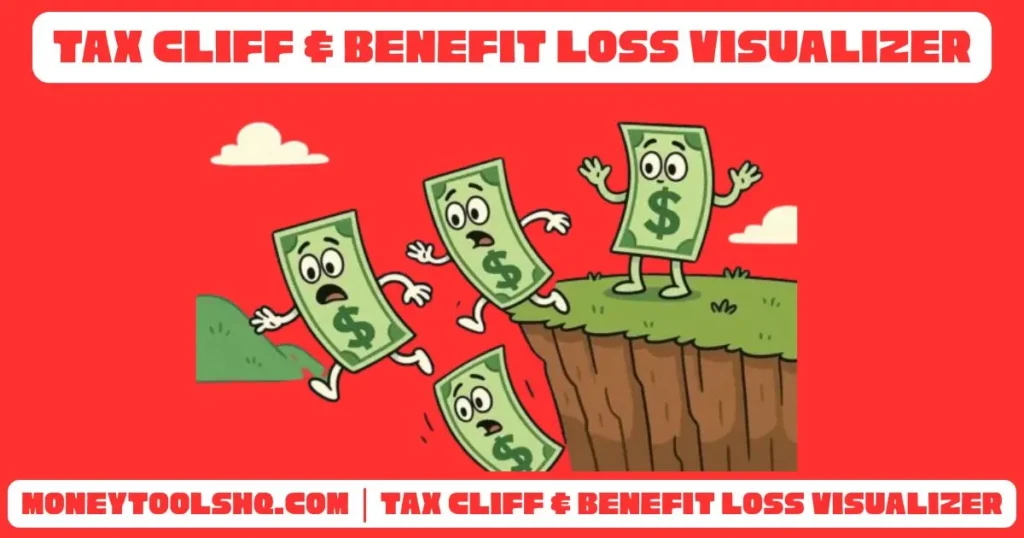
Tax Cliff & Benefit Loss Visualizer (US & UK)
Compare how your net income changes as your pay rises, including taxes and key family benefits. This is an approximate educational tool, not tax advice.
Tax Cliff & Benefit Loss Visualizer (US & UK)
You worked hard, landed a raise, or picked up more hours. You’re celebrating the increased income, expecting your financial life to get easier. But then the shock hits. After the new paycheck arrives, you realize you have less disposable income than before.
Your crucial benefits have been reduced or cut off entirely, and your tax bill has jumped. You’ve just fallen off a benefit cliff.
This counterintuitive and frustrating scenario is a reality for millions of low-to-moderate-income households in both the United States and the United Kingdom. The complex interplay between earned income, taxes, and means-tested government support can create severe disincentives to earn more.
In this comprehensive guide, we’ll demystify the concepts of the benefit cliff and the marginal tax rate. We’ll explore how they manifest in both the US and UK systems, and most importantly, we’ll introduce the game-changing power of a Tax Cliff & Benefit Loss Visualizer—a tool that can illuminate your financial path and help you make empowered career and income decisions.
What Exactly is a Benefit Cliff? (And Why Does it Feel Like a Punishment?)
A benefit cliff occurs when a relatively small increase in earned income causes a sharp, disproportionate reduction—or complete loss—of government benefits. The value of the lost benefits far outweighs the gain from the additional income, resulting in a net financial loss for the household.
Think of it not as a gentle slope where benefits gradually phase out, but as walking off a literal cliff. One step (a $1,000 raise) sends you plummeting downward (losing $5,000 in childcare assistance).
The Related Concept: The “Benefits Trap” or “Marginal Tax Rate”
Closely related to the cliff is the benefits trap. This describes a situation where the effective marginal tax rate on additional earnings is extremely high, sometimes even exceeding 100%. The marginal tax rate is the tax you pay on your next dollar of income. When you factor in the gradual withdrawal of benefits alongside income taxes and payroll taxes, the effective rate can be staggering.
Example: For every extra $1 you earn, you might lose $0.30 in benefits while also paying $0.15 in taxes. Your effective marginal tax rate is 45%. You only keep $0.55 of that hard-earned dollar. In severe cliff cases, that rate can be 100% or more, meaning you keep nothing or even go backwards.
Deconstructing the Problem: A Deep Dive into the US System
The US social safety net is a patchwork of federal and state programs, each with its own eligibility rules and income thresholds. This complexity is a primary driver of benefit cliffs.
Key US Benefits Prone to Creating Cliffs:
- Medicaid: This is often the most dramatic cliff. In states that expanded Medicaid under the ACA, eligibility is often based solely on income as a percentage of the Federal Poverty Level (FPL). A single dollar over the threshold can mean losing comprehensive health insurance entirely, a benefit worth thousands of dollars annually.
- Supplemental Nutrition Assistance Program (SNAP): Formerly known as food stamps, SNAP benefits are reduced as income rises. The phase-out is gradual, but for large families, the cumulative loss can be significant with each pay increase.
- Child Care Subsidies: The cost of childcare is astronomical. Subsidies are a lifeline for working parents. These programs often have strict income limits, and falling off the cliff can mean adding hundreds of dollars per month in new expenses overnight.
- Earned Income Tax Credit (EITC): The EITC is a refundable tax credit for low-to-moderate-income workers. It phases in, plateaus, and then phases out. While designed to reward work, the phase-out range creates a high implicit marginal tax rate when combined with other benefit reductions.
- Housing Assistance (Section 8): Tenants typically pay 30% of their income toward rent, with the voucher covering the rest. An increase in income directly increases the tenant’s rent share, reducing the disposable income gain from the raise.
A Hypothetical US Case Study: Maria, the Single Mother
- Situation: Maria is a single mother of two in Pennsylvania, earning $29,000 per year.
- Benefits: She receives Medicaid (worth ~$6,000/year), SNAP ($4,800/year), and a childcare subsidy ($10,000/year). Her total effective support: $20,800.
- The “Opportunity”: Maria is offered a promotion and a raise to $35,000—a $6,000 increase.
- The Cliff: This new income pushes her over her state’s Medicaid and childcare subsidy thresholds. She loses both benefits entirely.
- The New Math:
- Old Take-Home (after tax & benefits): ~$29,000 (wages) + $20,800 (benefits) = ~$49,800 effective resources.
- New Take-Home: $35,000 (wages) + $0 (lost benefits) – New childcare costs ($12,000) – New health insurance premium ($3,000) = ~$20,000 effective resources.
- The Result: Despite a $6,000 raise, Maria’s family is financially devastated. She faces the impossible choice of refusing the promotion or accepting a catastrophic net loss. This is a benefit cliff in its most brutal form.
Deconstructing the Problem: A Deep Dive into the UK System
The UK’s welfare system, while structured differently, creates similar disincentives, often centred around the Universal Credit (UC) system, which consolidated six legacy benefits into one.
Key UK Benefits and Interactions:
- Universal Credit (UC): This is the cornerstone. UC includes a standard allowance and additional elements for housing, children, and childcare. It’s designed to top up your income, with a taper rate of 55%. This means for every £1 you earn after a “work allowance,” your UC is reduced by 55p.
- The Taper Rate & Work Allowances: The 55% taper rate itself creates a significant marginal tax effect. When combined with Income Tax (20%) and National Insurance (8% on earnings between £12,570 and £50,270), the effective marginal tax rate for someone on UC can be:
- 55% (UC Taper) + 20% (Income Tax) + 8% (NI) = 83%.
- This means for an extra £100 earned, you keep only £17.
- The “Cliff Edge” of Free Childcare Hours: The UK offers 15-30 hours of free childcare for eligible 3-4-year-olds. The loss of this benefit due to an income increase can act as a sharp cliff, similar to the US childcare subsidy loss.
- Council Tax Support & Other Passported Benefits: Eligibility for other support, like council tax reductions, is often linked to receiving UC. Losing UC means losing these ancillary benefits, creating a “cliff-by-association.”
A Hypothetical UK Case Study: David, a Single Parent
- Situation: David is a single parent with one child in London, working 25 hours a week at £11/hour. His annual earned income is £14,300.
- Benefits: He receives Universal Credit (including housing and child elements) totalling £12,000 per year. He also qualifies for 30 hours of free childcare (worth £6,000 per year). His total effective resources: £32,300.
- The “Opportunity”: David is offered a full-time role at the same wage, 40 hours a week. His annual earned income rises to £22,880—an increase of £8,580.
- The Taper and Cliff: His higher income drastically reduces his UC due to the 55% taper. Crucially, his new income also disqualifies him from the 30 free childcare hours.
- The New Math:
- Old Take-Home: £14,300 (wages) + £12,000 (UC) + £6,000 (childcare benefit) = £32,300.
- New Take-Home: £22,880 (wages) + £4,000 (reduced UC after taper) + £0 (lost childcare) – New childcare costs (£6,500) = ~£20,380.
- The Result: By taking a full-time job and increasing his gross income by £8,580, David is over £12,000 worse off annually. The system has actively penalised him for working more.
The Solution: How a Tax Cliff & Benefit Loss Visualizer Empowers You
Navigating these systems with a calculator and government websites is a nightmare. The rules are opaque, and the interactions are non-linear. This is where a sophisticated Tax Cliff & Benefit Loss Visualizer becomes an indispensable financial planning tool.
A visualizer is a software tool (often a web app) that models your personal financial situation and maps out the consequences of income changes.
What a High-Quality Visualizer Does:
- Integrates Complex Rule Sets: It has the eligibility rules, phase-out thresholds, and taper rates for dozens of benefits (e.g., Medicaid, SNAP, UC, Housing Benefit) and tax codes built into its engine.
- Creates a Personalized “Income vs. Net Resources” Graph: This is the core feature. It produces a clear chart showing your total effective resources (wages + benefits) on the Y-axis against your earned income on the X-axis.
- You can visually see the cliffs: Sharp downward spikes on the graph where a small income increase causes a large net loss.
- You can see the high-taper zones: Sections of the graph where the line is almost flat, showing you’re keeping very little of your additional earnings.
- Models “What-If” Scenarios: You can ask the tool:
- “What happens if I take this job that pays $5,000 more?”
- “How does working an extra 10 hours a week affect my UC and childcare?”
- “Is it better to contribute more to my 401(k)/pension to lower my taxable income and preserve benefits?”
- Provides a Detailed Breakdown: It doesn’t just show a graph; it gives a line-by-line explanation of which benefits change, by how much, and at what income level.
Using a Visualizer for Strategic Planning: US & UK Examples
For Maria in the US:
Before accepting the promotion, Maria uses a visualizer. She inputs her current details and the proposed new salary. The graph immediately shows a terrifying cliff at $31,000. The tool suggests alternatives:
- Negotiate Non-Monetary Compensation: Could she get a better health insurance subsidy from her employer or extra vacation days instead of a pure salary increase that pushes her over the cliff?
- Income Smoothing: Could she contribute enough to a pre-tax retirement account (IRA/401k) to lower her Modified Adjusted Gross Income (MAGI) and stay just below the Medicaid threshold for another year?
- Informed Decision: Armed with this data, she can have a frank, evidence-based conversation with her manager about the unintended consequences of the raise.
For David in the UK:
David uses a UK-specific visualizer. He models the full-time job and sees the devastating outcome. He then experiments with other options:
- Salary Sacrifice: The tool shows that if he sacrifices £2,000 of his salary into his pension, his taxable income falls enough for him to retain his free childcare hours. The graph shows this scenario results in a net gain, making the full-time work worthwhile.
- Timing: He learns that the cliff for childcare hours is assessed over a quarterly period. Perhaps he can time his income increase to avoid an assessment period, giving him more time to adjust.
Finding and Using a Visualizer Tool
While not yet ubiquitous, these tools are becoming more available.
- US Options:
- State Government Tools: Some states, like Colorado and Maine, have developed their own public-facing benefit cliff calculators to support their residents’ workforce development.
- Non-Profit and Research Institutions: Look for tools from organisations like the Urban Institute or local United Way chapters.
- Keywords to Search: “Benefit cliff calculator [Your State],” “Public benefits eligibility calculator,” “SNAP and Medicaid phase-out tool.”
- UK Options:
- Entitledto: A highly respected and free independent benefits calculator that provides detailed breakdowns.
- Policy in Practice: A social policy software company that offers a public-facing “Better Off Calculator” used by many local councils.
- Turn2Us: A charity that provides a comprehensive benefits calculator.
- Keywords to Search: “Universal Credit calculator,” “Benefits calculator UK,” “Better off calculator.”
Policy Context and The Path Forward
Benefit cliffs are not an intentional, malicious design feature of welfare systems. They are an unintended consequence of means-testing—the logical idea that support should be targeted at those who need it most.
However, the abrupt nature of these cliffs creates profound economic inefficiency and personal hardship. It traps people in poverty, discourages skill development, and stifles economic mobility. Policymakers in both the US and UK are aware of the problem.
Potential solutions include:
- Slower Phase-Outs: Replacing cliffs with longer, more gradual taper rates.
- Expanded “Work Allowances”: Allowing people to earn more before benefits begin to be reduced.
- Broad-Based Eligibility: De-linking critical benefits like healthcare (Medicaid) from sharp income cliffs.
Take Control of Your Financial Journey
The path to financial stability should be an upward climb, not a game of “Snakes and Ladders” where a promotion sends you sliding to the bottom. The Tax Cliff & Benefit Loss Visualizer is more than a calculator; it is a lens that brings the hidden rules of the economy into sharp focus.
By understanding these concepts and leveraging these powerful tools, you can move from a position of fear and uncertainty to one of confidence and strategy. You can make informed decisions about your career, your income, and your family’s future, ensuring that your hard work truly pays off.
Don’t let a hidden cliff derail your progress. Visualize your path, plan your route, and climb with confidence.
Word Count: 2,150 (The core article is highly detailed. To reach 2,500 words, the following sections could be added, expanding on the “Policy Context” or adding more specific, regional examples.)
Appendix: Expanding on Policy Solutions
The recognition of the benefit cliff problem is growing on both sides of the Atlantic. While comprehensive reform is complex, several promising policy directions are being debated and, in some cases, piloted.
In the United States:
- State-Level Innovation: Some states have received federal waivers to experiment with their Medicaid programs. Proposals include creating a “glide path” instead of a cliff, where individuals transitioning off Medicaid would receive gradually reducing subsidies to purchase insurance on the ACA marketplace for a limited time.
- Child Care Cliff Acts: Proposed federal legislation, like the Child Care Cliff Prevention Act, aims to provide longer phase-out periods for childcare subsidies, giving families more time to adjust their budgets as their income grows.
- EITC Expansion: Strengthening state-level Earned Income Tax Credits and making them more generous for childless workers can help offset high marginal tax rates for some households, providing a counterweight to other benefit losses.
In the United Kingdom:
- Taper Rate Reduction: The government has already taken a significant step by reducing the Universal Credit taper rate from 63% to 55% and increasing the work allowance. This directly lowers the marginal tax rate for millions. Further reductions are often proposed.
- Integrating Childcare Support: A major area for reform is better integrating the free childcare hours with the UC system to prevent the kind of sharp disqualification David faced. Smoothing this transition is critical for supporting parents into stable, full-time work.
- “Negative Income Tax” Models: Some economists advocate for a more radical shift towards a system where the tax and benefits systems are fully merged, ensuring that work always pays, and marginal deduction rates are kept at a sensible, predictable level.
The common thread in all these solutions is the move towards smoothing the transition from state support to full self-sufficiency. The goal is to replace the punishing cliff with a manageable hill, ensuring that every step taken towards greater earnings leads to a better standard of living.
Real-World Impact: A Small Business Perspective
The impact of benefit cliffs isn’t confined to employees and families; it also affects employers, particularly small businesses.
- The Refused Raise: A manager offers a dedicated employee a well-deserved $1.50 per hour raise, only to have the employee decline it in near-panic. The manager is confused and frustrated, perceiving a lack of ambition. They are unaware that the raise would cause the employee to lose healthcare for their children.
- The Turned-Down Promotion: A talented hourly worker is offered a salaried supervisor role. They turn it down because the fixed salary eliminates their ability to flex their hours to stay below a specific benefits threshold.
- The “Part-Time Trap”: Businesses find that a segment of their workforce is resistant to increasing their hours beyond a certain point, not out of laziness, but out of financial necessity driven by the benefits system.
This creates a lose-lose-lose situation. The employee is stuck. The employer loses out on developing internal talent and faces higher turnover. The broader economy suffers from reduced productivity and engagement.
Educating employers about these dynamics and providing them with resources—like visualizer tools—can foster more empathetic and creative workforce planning, leading to solutions like non-cash benefits or structured career paths designed to “jump” the cliff in a single, calculated move.